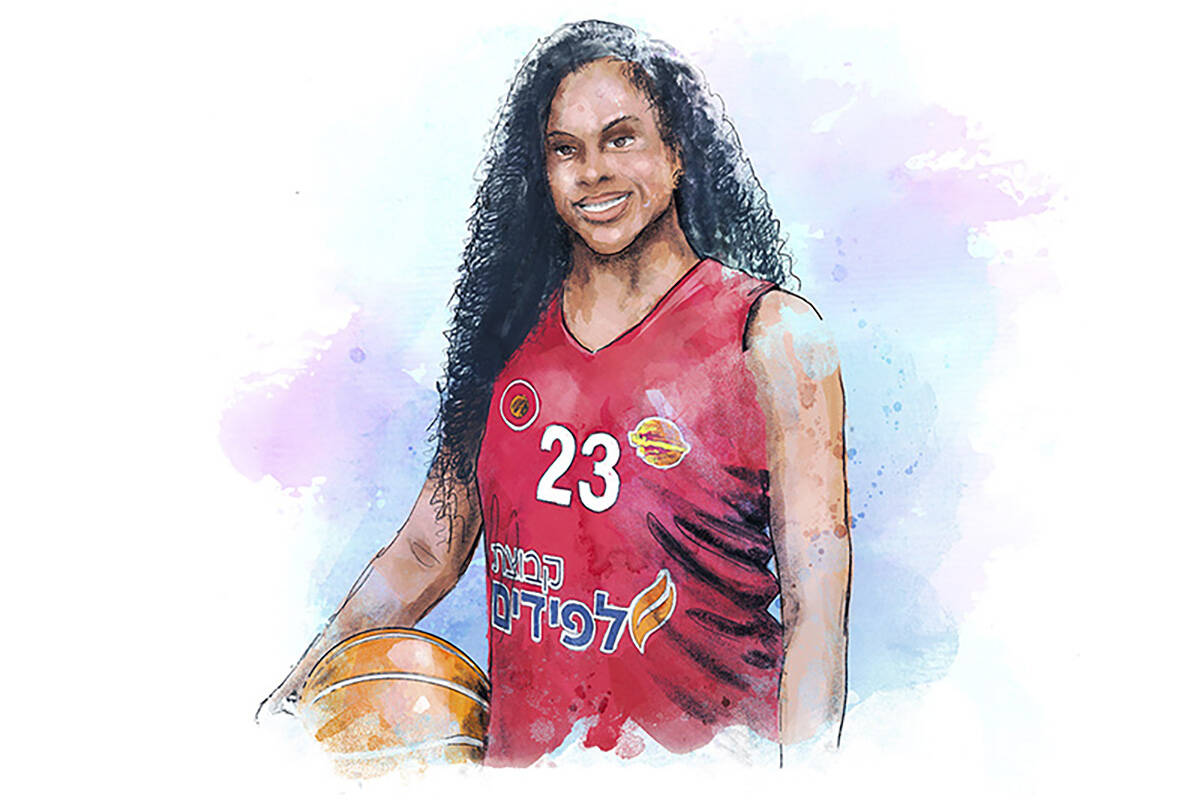
Desi-Rae Young sat in the stands at the Thomas & Mack Center on Sunday, watching her former UNLV teammates play in the Mountain West tournament. But her eyes kept drifting to her phone—a habit born from weeks of scanning for updates from friends still trapped in a war zone 7,400 miles away.
Young, 24, returned to Las Vegas on March 6 after her professional season in the Israeli Women’s Basketball Premier League was suspended when the U.S. and Israel launched wide-ranging strikes on Iran on Feb. 28. She had been averaging 16 points and eight rebounds per game for Hapoel Rishon LeZion under coach Ziv Erez.
“They go through it all the time. All we would do is shelter in place and text each other, and that’s basically all we did while we were there. I’m still in touch with them to this day,” Young said.
Young, a Desert Oasis High School graduate and two-time Mountain West Player of the Year, is one of the most decorated players in UNLV history. She made three NCAA Tournament appearances with the Lady Rebels before graduating in 2024.
Too close for comfort
Before escaping, Young’s daily routine involved sitting on a mattress in her apartment’s bomb shelter—a room with fortified walls and a bullet-proof door and window. From there, she watched live CNN coverage of a war being waged less than 15 miles away in Tel Aviv.
“I watched a lady die. It was all on (Instagram) Live. The missile hit, and she was gone,” Young said. “I could hear the explosions. It wasn’t like it was right next door to me, but it sounded like it was right there.”
Her mother, Beverly Williams, had pleaded with her not to go to Israel. “I was thinking, why Israel? Why didn’t you go somewhere like Switzerland or Europe? The Middle East is dangerous. Of course I was scared. But she was determined,” Williams recalled.
Young acknowledged the danger but said she went for “business purposes.” She had played six weeks in Rwanda before her agent called with the Israeli offer, a more competitive opportunity she felt she couldn’t pass up. “I knew what I was getting myself into, so I wasn’t as worried as my mom. But we’re in the Middle East. Things are going to happen. I knew the risk,” she said.
Realities of playing overseas
When the season was paused, Erez drove Young four hours to the Egyptian border, then arranged for a driver to take her to Cairo’s airport. She flew to Istanbul, then to Los Angeles, and finally drove to Las Vegas.
Erez, 60, has lived in Israel his entire life. “We get used to this for the last five years. We got COVID, and then we got the war in Gaza, and then we got this, the Iran war. So unfortunately, we got experience in this. It’s not fun. … But for our Desi, it’s something special, because she’s a really wonderful person. She’s a great player,” he said.
Despite the ordeal, Young said she enjoyed Israel’s beaches and food, calling it a “vacation” destination. She lamented that her team won’t get to finish what they started. “So many people had it worse than me,” she said, though Erez noted that Rishon LeZion experiences air raid sirens six to eight times per day.
Erez hopes the season will resume and wants Young to return. He has been turned down before by players whose parents forbade it. But Young’s stepfather, Steve Ridgell, said, “I knew she was going to be OK, because she had a purpose. She’s strong. She’s not a scary person.”