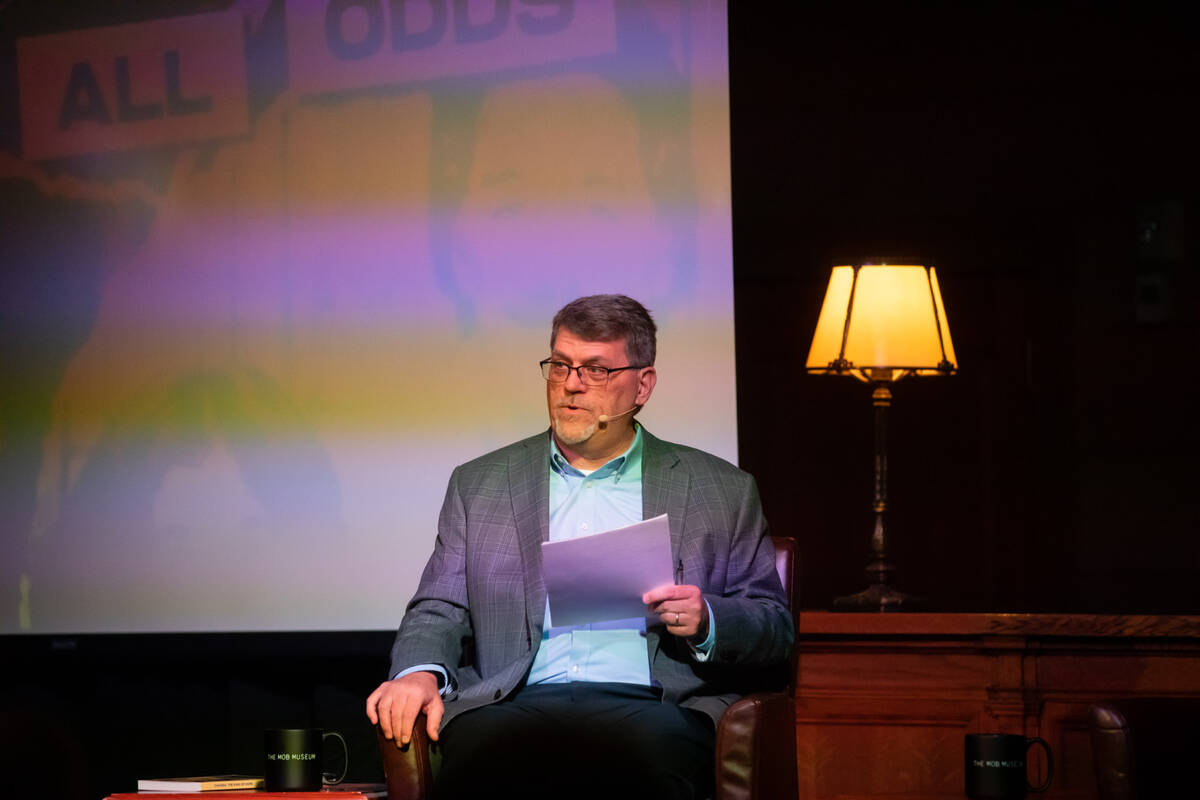
The recent federal arrests of former Portland Trail Blazers coach Chauncey Billups, Miami Heat guard Terry Rozier, and ex-NBA player Damon Jones as part of an organized crime-backed gambling ring are just the latest chapter in a story that stretches back more than a century, according to Geoff Schumacher, vice president of exhibits and programs at the Mob Museum in Las Vegas.
“Sports betting scandals are nothing new,” Schumacher said. “The World Series was probably the biggest one of all.”
He was referring to the 1919 Black Sox Scandal, in which eight Chicago White Sox players conspired with gamblers—allegedly including New York crime boss Arnold Rothstein—to throw the World Series against the Cincinnati Reds. A ticket from that series is displayed at the museum.
“There is a long history of organized crime being involved in sports—whether they’re fixing boxing matches or horse races or basketball—and it appears it’s not ending anytime soon,” Schumacher added.
The October 2025 takedown resulted in 34 arrests across two sprawling gambling operations linked to illegal sports betting and rigged poker games. In January, 26 people were charged in a separate point-shaving scheme that involved at least 39 players on 17 NCAA Division I men’s basketball teams fixing or attempting to fix more than 29 games.
Las Vegas gambler “Sugar” Shane Hennen and Marves Fairley were charged in both cases. Hennen is accused of placing over $200,000 in bets on Rozier to finish under his individual prop bets based on inside information that Rozier would leave a 2023 game early with an injury. In a similar scheme, Hennen bet big on former Toronto Raptors player Jontay Porter to go under his props, including an $80,000 parlay that would have paid $1 million before being canceled. Porter was banned for life from the NBA.
“One reason scandals are popping up right now is the prop bets,” Schumacher said. “It’s just a little easier to manipulate a game if all you have to do is determine how many points one player gets.”
Illegal gambling has long been a revenue source for organized crime. Former mob boss John Gotti reportedly lost up to $100,000 a week on sports bets in the 1980s. “One of the reasons I think that mobsters got involved with trying to fix sporting events was a lot of them were bad gamblers,” Schumacher said.
In contrast, Frank “Lefty” Rosenthal—portrayed by Robert De Niro in the film “Casino”—was a sharp bettor who provided advice to mobsters. Rosenthal launched the first modern race and sportsbook at the Stardust casino on the Las Vegas Strip. His license was rejected twice after his history as an illegal bookie and sports fixer came to light. In 1960, he was indicted for attempting to bribe a New York University basketball player and later charged with trying to bribe an Oregon football player.
Richard “The Fixer” Perry, known for a 1991 photo of him in a hot tub with three UNLV basketball players, pleaded guilty in 1984 to conspiracy in the 1978 Boston College point-shaving scheme. He was also convicted in a 1974 harness racing scandal. Both cases involved the Lucchese crime family, including mobster Henry Hill, subject of the film “Goodfellas.”
“My initial thoughts always turn to organized crime and the focus of our museum, which came into play in a big way with the sports betting scandal where the New York Mafia families were allegedly involved,” Schumacher said. “And now there’s this connection between the first set of indictments and the second set. These two common individuals who suggest this is clearly a conspiracy involving multiple people in an ongoing way. So this definitely fits the definition of organized crime.”